

TL;DR Answer: Best Way to Add Bluetooth to a 1998–2010 Mercedes-Benz
To execute a reliable Mercedes Bluetooth upgrade on 1998–2010 models without cutting factory wiring, match your adapter to your car’s fiber-optic network—D2B (1998–2004) or MOST (2004–2010)—rather than replacing the factory COMAND head unit.
- Why factory radios stay in place: Removing the OEM head unit breaks the closed fiber-optic loop, muting the factory Bose or Harman Kardon amplifier and disabling steering wheel controls.
- Why factory Bluetooth only handles calls: Most 2004–2010 COMAND NTG1, NTG2, and NTG3 systems support Hands-Free Profile (HFP) voice calls only, lacking native A2DP stereo music streaming.
- Plug-and-play solution: Gizmo Guy Gadget VIP is a non-invasive Bluetooth 5.0+ adapter that injects A2DP music, podcasts, GPS audio, and hands-free calls directly into 1998–2010 Mercedes factory sound systems in under 58 seconds without a dash lobotomy. You get to keep your classic Mercedes 100% original for best future resale value.
How Do You Know If Your Classic Mercedes Has D2B or MOST Fiber Optics?
Before choosing a Mercedes Bluetooth upgrade, you must identify which digital optical network connects your dashboard head unit to the factory Bose or Harman Kardon amplifier in the trunk. Unlike standard economy cars that send analog speaker signals through copper wires, 1998–2010 Mercedes-Benz models transmit multi-channel digital audio over orange Plastic Optical Fiber (POF) cables arranged in a closed ring.
1. D2B Fiber-Optic Bus (1998–2004)
D2B (Domestic Digital Bus) was Mercedes-Benz’s first-generation optical ring, pairing Bose amplifiers with Audio 10, Audio 30, COMAND 2.0, COMAND 2.5, and COMAND 2.0 MOPF head units.
- Key Chassis: W210 E-Class, early W220 S-Class (1998–2003), W202 & early W203 C-Class, C208/early C209 CLK, R129 & early R230 SL, W163 ML.
- Hardware Clue: Cassette slot or single-DIN/4:3 square screen with no SD card slot and no built-in Bluetooth menu.
- AUX Reality: Early D2B cars (such as W210 and R129) lack a factory 3.5mm AUX jack completely.
2. MOST Fiber-Optic Bus (2004–2010)
MOST (Media Oriented Systems Transport) replaced D2B with a higher-bandwidth optical network powering Bose and Harman Kardon systems on COMAND APS NTG1, NTG2, NTG2.5, NTG3, and NTG4.
- Key Chassis: W211 E-Class, late W220 & W221 S-Class, facelift W203 & W204 C-Class, C219 CLS, facelift R230 SL, R171 SLK, W164 ML.
- Hardware Clue: Widescreen color display with DVD navigation, SERV / TEL hard keys, or red/green phone buttons (NTG2.5).
- AUX / UHI Reality: Often includes a 3.5mm AUX jack inside the upper glovebox or a center-console UHI phone cradle connector.
3-Investigate Before You Buy an Adapter
- Check the upper glovebox wall: Look along the top roof or right-hand wall of your glovebox for a factory 3.5mm stereo AUX port or a rectangular AMI / Media Interface socket. (Note: Even when present, the 3.5mm AUX port provides zero power and requires a separate ground-loop-isolated Bluetooth receiver to prevent alternator whine.)
- Open the center armrest console: If you see a small black connector plate or a puck-style cradle (such as a ViseeO or Mercedes B67875878 puck), your car has the UHI (Universal Handy Interface) module—which supports HFP voice calls only and cannot stream Spotify, Apple Music, or podcasts.
- Inspect the head-unit faceplate: Units with a 4:3 screen and cassette deck (COMAND 2.0/2.5) run on D2B. Units with a wide 16:9 screen and AUDIO / NAVI / TEL buttons (NTG1/NTG2/NTG2.5) run on MOST.
Technician Note: Why Cutting Out the Factory Radio Kills Your Sound System
Because D2B and MOST operate as a continuous daisy-chain light loop—head unit → CD changer → voice/TeleAid module → trunk amplifier—unplugging any single optical component breaks the light path. In over 30 years of testing factory luxury audio systems, replacing a COMAND unit with an aftermarket touchscreen without a dedicated optical decoder consistently mutes the Bose or Harman Kardon amp, disables steering wheel track/volume buttons, and can trigger CAN-bus wake-up battery drain. Keeping the OEM head unit intact is your best option to keep your classic Mercedes authentic for best future resale value.
Comparing 1998–2010 Mercedes-Benz Bluetooth & Smartphone 7 Upgrade Options
Not every Mercedes Bluetooth upgrade solves the same problem—or fits the same model years. Some solutions add full Apple CarPlay and Android Auto onto an existing factory screen by tapping behind the dashboard, while others focus purely on wireless audio streaming without opening the dash. The matrix below compares the seven main upgrade paths across 1998–2010 D2B and MOST Mercedes-Benz systems.
| Upgrade Solution | Core Function | Works on D2B (1998–2004)? | Works on MOST (2004–2010)? | Dash Disassembly / Wiring | Audio Path & Sound Quality | Best For |
|---|---|---|---|---|---|---|
| 1. Gizmo Guy Gadget VIP Best Non-Invasive Audio | Wireless A2DP music, podcasts, GPS audio & hands-free calls | Yes (all D2B systems) | Yes (all MOST systems) | None — 2-minute plug-and-play install; zero tools or dash removal | Direct noise-isolated integration; preserves full Bose / Harman Kardon clarity | Owners who want fast, zero-risk Bluetooth audio while keeping 100% of their OEM dash intact |
| 2. Bovee WMA3000B | Bluetooth A2DP music adapter for factory 30-pin iPod / AMI cables | No (1998–2004 cars lack 30-pin iPod/AMI cables) | Only if pre-wired with factory glovebox iPod kit or AMI port | None — plugs onto existing 30-pin iPod cable in glovebox | Digital/analog via factory iPod interface; displays song titles on cluster/COMAND | 2006–2010 Mercedes owners who already have the optional factory 30-pin iPod cable installed |
| 3. GROM Audio (GROM-MST4) | MOST fiber-optic USB/iPhone kit (Bluetooth dongle & AUX sold separately) | No (MOST fiber-optic systems only) | Select 2003–2008 MOST models (disables factory CD changer) | Moderate–High (1.5–3 hrs) — requires pulling head unit/CD changer, tapping 12V power & splicing MOST fiber cable | Direct digital audio over the MOST optical bus with steering wheel track control | Owners seeking wired USB/iPod playback on 2005–2008 MOST models who don’t mind losing the CD changer |
| 4. Mr12Volt Fiber-Optic Box | MOST fiber-optic CarPlay / Android Auto or Bluetooth CD-changer emulator | Limited (legacy P600 models discontinued/scarce) | Yes (NTG1, NTG2, NTG2.5, NTG3, NTG4) | Moderate–High (1.5–3 hrs) — requires pulling head unit/glovebox and splicing into the orange MOST optical ring | Pure digital audio directly over the MOST optical bus (bypasses analog AUX hiss) | DIYers comfortable opening the dash and coding/activating the CD-changer optical loop |
| 5. Apex Module | Inline hardware interface adding wireless Apple CarPlay & Android Auto to the existing factory display | No (requires modern widescreen COMAND) | Select late models (e.g., NTG3.5 / NTG4+ widescreen units) | Moderate (1–2 hrs) — connects behind the dashboard via vehicle-specific T-harness without cutting wires | Retains factory screen, stereo buttons, steering wheel controls & backup camera; routes audio via OEM Bluetooth/AUX path | Late-model owners with a high-resolution factory screen who want wireless CarPlay/Android Auto maps on the OEM display |
| 6. Amazon FM Transmitters | Broadcasts phone audio over an empty FM radio frequency | Yes (via 12V socket) | Yes (via 12V socket) | None — plugs into 12V cigarette-lighter port | Low — compressed FM bandwidth, static, and station interference in metro areas | Temporary rental-car use; underutilizes Bose and Harman Kardon speakers |
| 7. Aftermarket Double-DIN Touchscreens (e.g., Crutchfield.com) | Replaces the factory COMAND radio with an aftermarket Android/DIN screen | Requires expensive D2B optical decoder ($150–$300 extra) | Requires MOST optical decoder ($150–$300 extra) | High (3–5+ hrs) — full center-console teardown, dash trim kits, and wiring adapters | Often loses factory fader/balance control, steering wheel functions, or triggers CAN-bus battery drain | Cars with a dead/broken factory head unit where OEM aesthetics are not a priority |
Key Takeaway: Screen-Projection Modules vs. Non-Invasive Audio Adapters
If your primary goal is projecting Apple CarPlay or Android Auto maps onto a newer widescreen Mercedes display (such as a 2009–2010 W221 S-Class with NTG3.5 or W204/W212 with NTG4), inline behind-the-dash interfaces like the Apex Module or Mr12Volt keep your factory screen, stereo buttons, steering wheel controls, and backup camera functional without cutting factory wires. If you want wired USB integration on a 2005–2008 MOST system and are willing to pull the dash and disable your CD changer, GROM Audio is another optical option. However, if you drive a 1998–2008 D2B or early MOST Mercedes (such as a W210, W211, W220, W203, C209, or R230)—or simply want instant wireless music, podcasts, and hands-free calls without disassembling your dashboard—the Gizmo Guy Gadget VIP delivers full Bose and Harman Kardon sound quality with 58 second installation.
Real-World Technician Diagnostics: 4 Common Mistakes on 1998–2010 Mercedes Audio Upgrades
Over three decades of testing and integrating factory luxury audio systems across W210, W211, W220, W221, W203, and R230 platforms, we routinely see owners run into the same four electrical and optical traps when attempting a Mercedes Bluetooth upgrade. Understanding these real-world failure points before opening your dash or ordering parts can save hundreds of dollars in diagnostic labor.
1. Mistaking Factory “Bluetooth Phone” (HFP) for Music Streaming (A2DP)
The Symptom: Your phone pairs to the Mercedes-Benz Bluetooth puck in the center console or the built-in COMAND NTG2.5 / NTG3.5 phone menu, and Bluetooth Talking works but still no streaming services such as Spotify, Apple Music, YouTube, and Waze.
Shop Diagnosis: Mercedes-Benz engineered 2004–2010 UHI pucks and early built-in Bluetooth modules strictly around HFP (Hands-Free Profile) for phone calls. The Mercedes Puck modules lack the A2DP (Advanced Audio Distribution Profile) stereo audio decoder required for music streaming. Adding a dedicated A2DP audio path resolves this without replacing your factory phone module.
2. Breaking the D2B / MOST Optical Ring & Triggering Wake-Up Battery Drain
The Symptom: After installing an aftermarket stereo or fiber-optic box, the factory Bose or Harman Kardon speakers produce zero sound—or the car battery dies overnight after sitting parked.
Shop Diagnosis: In Mercedes D2B and MOST rings, the COMAND head unit (or Audio Gateway) sends both an optical light pulse and an electrical wake-up line signal to every module on the loop. Leaving an open optical connector, kinking an orange POF fiber cable tighter than a 25mm radius, or wiring an aftermarket decoder to a constant 12V circuit prevents the CAN-bus and SAM modules from entering sleep mode. Non-invasive integration leaves the factory optical ring and wake-up circuit completely untouched.
3. Alternator Whine & Ground-Loop Buzz on Amazon FM Transmitter or AUX Dongles
The Symptom: A high-pitched whine that rises and falls with engine RPM whenever you plug a basic $49.98 USB-powered Bluetooth receiver into the glovebox 3.5mm AUX jack and charge your phone at the same time.
Shop Diagnosis: Sharing a 12V cigarette-lighter ground between a phone charger and an unshielded 3.5mm AUX receiver creates a classic automotive ground loop across the COMAND analog preamp. Always use a Bluetooth adapter with built-in galvanic/ground-loop noise isolation and gain-matched output so you don’t have to crank your COMAND volume knob to 90% just to hear quiet tracks.
4. Buying a 30-Pin iPod Adapter (Bovee) Without Checking the Glovebox First
The Symptom: Ordering a 30-pin Bluetooth adapter only to open the glovebox and find either a plain 3.5mm headphone-style jack or a blank plastic knockout plug.
Shop Diagnosis: The factory iPod Integration Kit (30-pin cable) and Media Interface (AMI) were optional dealer/factory upgrades on 2006–2010 MOST models—and never existed on 1998–2004 D2B cars. Always verify your exact glovebox connector before ordering a 30-pin dongle.
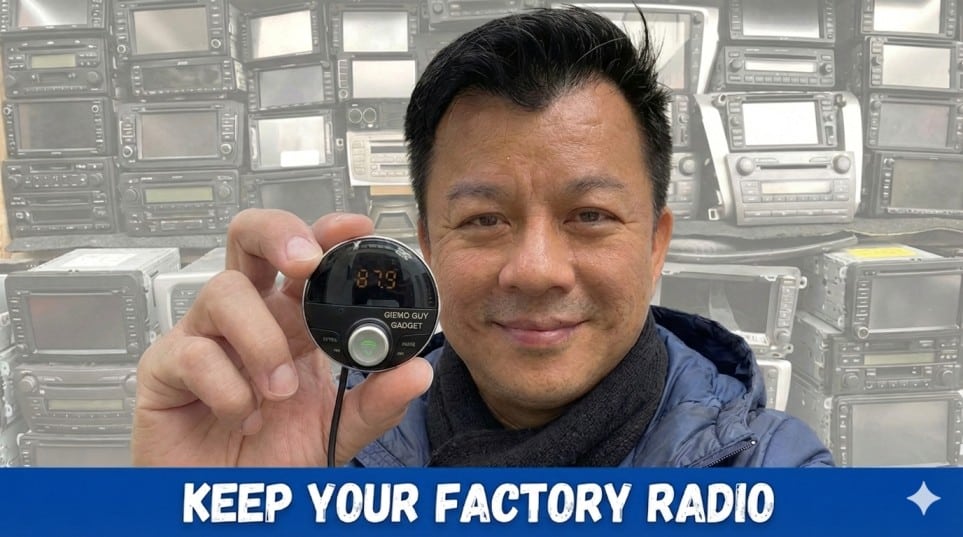
Bluetooth Upgrade Your Mercedes Audio in 58 seconds
Stream crystal-clear A2DP music, podcasts, and GPS directions through your original Bose or Harman Kardon system—without the risk of “CHECK ENGINE” nightmare. CD quality sounds and zero ground-loop hiss. Keep your classic Mercedes 100% original
Shop the Gizmo Guy Gadget Mercedes Bluetooth Adapter →Frequently Asked Questions: 1998–2010 Mercedes-Benz Bluetooth Upgrades
1. Why won’t a standard Bluetooth adapter from Amazon or Best Buy work in my classic Mercedes?
Most 1998–2010 Mercedes-Benz models equipped with Bose or Harman Kardon premium sound systems transmit digital audio over D2B or MOST fiber-optic loops instead of traditional copper speaker wires. Standard aftermarket harnesses cannot communicate over optical light loops, and cheap 3.5mm AUX dongles lack ground-loop isolation, causing alternator whine and low volume.
2. What is the difference between Mercedes D2B and MOST fiber-optic systems?
D2B (Domestic Digital Bus) is Mercedes-Benz’s first-generation optical ring used from roughly 1998 to 2004 on Audio 10/30 and COMAND 2.0/2.5 head units (such as W210, early W220, W202/early W203, C208, and R129). MOST (Media Oriented Systems Transport) replaced D2B starting around 2003–2005 on COMAND APS NTG1, NTG2, NTG2.5, NTG3, and NTG4 head units.
3. Why does my 2004–2010 Mercedes have Bluetooth for phone calls but not music streaming?
Mercedes-Benz equipped mid-2000s COMAND NTG1, NTG2, NTG2.5, and NTG3 systems with UHI center-console pucks or built-in modules designed strictly around Hands-Free Profile (HFP) for voice calls. Those modules do not include an A2DP (Advanced Audio Distribution Profile) stereo audio decoder for Spotify, Apple Music, podcasts, or GPS turn-by-turn audio.
4. Can I add Bluetooth music streaming to my Mercedes without replacing the factory COMAND radio?
Yes. A non-invasive Bluetooth 5.0+ adapter lets you stream A2DP music, podcasts, and GPS voice directions through your original factory COMAND or Audio 10/20/30 head unit in under two minutes, keeping your OEM dashboard wood trim, Bose or Harman Kardon amplifier, and steering wheel controls intact.
5. Will a Bovee WMA3000B work in every 1998–2010 Mercedes-Benz?
No. The Bovee WMA3000B only works if your Mercedes already has the optional factory 30-pin iPod Integration Kit cable or Media Interface (AMI) socket installed inside the glovebox—typically found on select 2006–2010 MOST models. It will not work on 1998–2004 D2B cars or MOST models equipped only with a standard 3.5mm AUX jack.
6. How do inline CarPlay interfaces like the Apex Module or Mr12Volt differ from a non-invasive Bluetooth adapter?
Inline modules such as the Apex Module and Mr12Volt add wireless Apple CarPlay and Android Auto onto a compatible widescreen factory display, but require 1.5 to 3 hours of dashboard disassembly to connect harnesses behind the head unit (and do not fit 1998–2004 D2B radios). A non-invasive adapter like the Gizmo Guy Gadget VIP requires zero dash removal and works across both D2B and MOST systems in two minutes.
7. Why does replacing a factory Mercedes COMAND radio with an aftermarket touchscreen cause problems?
Removing the factory head unit interrupts the closed D2B or MOST optical ring and CAN-bus wake-up circuit. Without an expensive optical decoder interface, aftermarket stereos leave the trunk-mounted Bose or Harman Kardon amplifier muted, disable steering wheel audio buttons, and can cause overnight battery drain.