

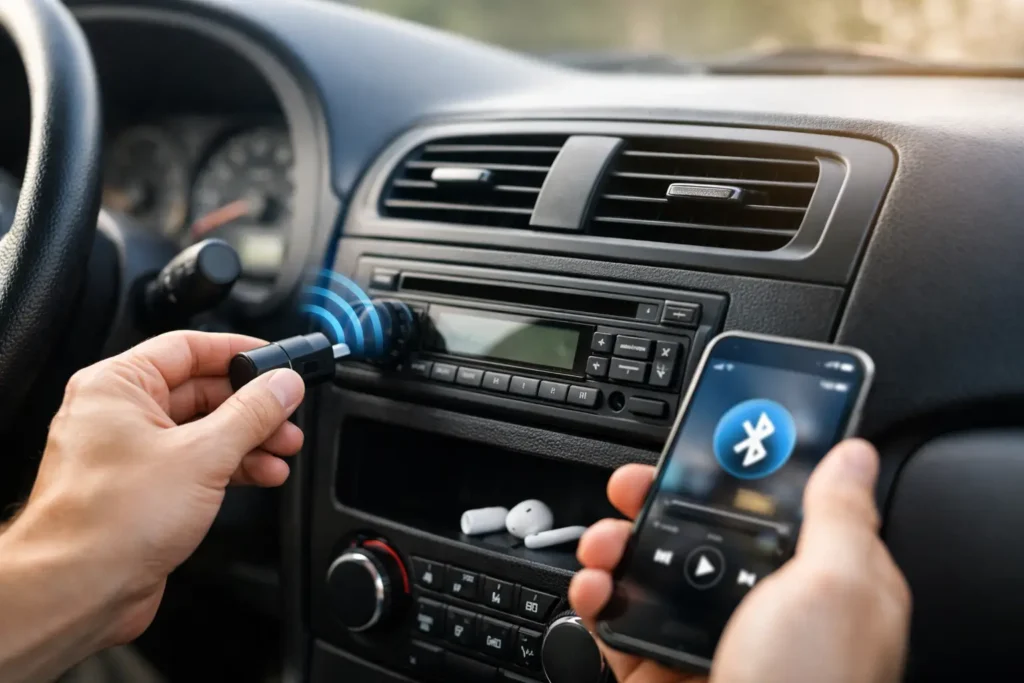
The moment most owners finally decide to add bluetooth to old car stereos is usually the same moment they get tired of the nonsense. You buy a nice older Mercedes, BMW, Lexus, Corvette, Porsche, or Audi because it still feels solid, still looks right, and still has a cabin newer cars can’t fake. Then you try to play music or take a call, and suddenly you’re dealing with dongles, static, ugly wires, or some parts-store gadget that sounds like a bad radio station from 2004.
That is the fork in the road. You can hack around the problem, or you can fix it in a way that respects the car.
The right way to add bluetooth to old car audio
If you own an older luxury or enthusiast car, the goal usually is not “get any Bluetooth at any cost.” The real goal is simpler – keep the factory look, keep the sound quality, and stop fighting with workarounds every time you drive.
That matters because not every Bluetooth solution is solving the same problem. A college beater with a loose cigarette lighter and a missing trim panel can get away with a lot. A well-kept E46, W211, C5 Corvette, LS430, 997, or B7 A4 is different. In those cars, a cheap fix often looks cheap, sounds cheap, or both.
So before you buy anything, decide what you actually care about. If all you want is occasional music in a commuter, one route makes sense. If you care about OEM appearance, strong sound, and not butchering the dash, another route makes a lot more sense.
Your options, from cheapest to best
There are really four common ways to add Bluetooth to an older car, and each has trade-offs.
FM transmitters
This is the bargain-bin answer. Plug it into a power outlet, pair your phone, tune the radio, and hope for the best. Sometimes it works well enough for a while. More often, it brings background hiss, weak volume, interference from local stations, and the constant irritation of finding a clear frequency.
For a lot of owners, FM transmitters are the thing they try first and regret first. They are cheap for a reason. If you drive a premium car with a factory system that still sounds great on CD or radio, an FM transmitter usually turns that system into the worst version of itself.
Bluetooth-to-AUX adapters
If your car already has a true auxiliary input, this can be a decent middle ground. Audio quality is usually much better than FM because you’re feeding signal directly into the system instead of broadcasting it through the air like a tiny pirate station.
The catch is that many older luxury cars either don’t have AUX at all or hide it behind model-year quirks, option packages, and weird factory architecture. Even when AUX is available, you may still end up with loose wires, a powered adapter living in the console, and call quality that feels like an afterthought.
Aftermarket head units
This route gives you modern features fast. CarPlay, Android Auto, touchscreen, backup camera support – all of that can be useful. But there is a cost beyond the receipt.
In older premium cars, replacing the factory radio often means changing the whole character of the dash. Sometimes you lose that clean original look. Sometimes steering wheel controls, factory amps, CD changers, or display functions get messy. Sometimes the install looks fine in photos and wrong in person. If you’re preserving a future classic, this is the point where many owners tap out.
Vehicle-specific factory integration kits
This is the route that makes the most sense when you want Bluetooth without the usual penalties. A proper integration kit is designed to work with the factory system, not replace it. That means the original head unit stays in place, the dash stays stock-looking, and the sound is dramatically better than the FM-transmitter circus.
This matters even more in 1998-2012 vehicles with premium factory audio and fiber optic systems. Those cars were not built around generic universal adapters, and they don’t always respond well to cheap electronics pretending to be one-size-fits-all. A vehicle-specific kit is built around that reality.
Why older luxury cars are different
A lot of generic advice online treats every old car the same. That is how people end up buying the wrong thing.
A base-model economy car with a simple radio is one problem. A Mercedes with MOST fiber optics, a BMW with DSP-era components, a Lexus premium system, or a Bose-equipped Corvette is another. These systems can sound fantastic when fed the right signal. They can also expose junk hardware immediately.
That is why owners who care about their cars usually stop chasing universal fixes after the first bad experience. They want something made for the platform, not something made for a warehouse shelf.
What actually matters when choosing a solution
Sound quality is the first thing people notice. If your Bluetooth setup adds hiss, compression, weak output, or random noise, it does not matter how cheap it was. You will hear the compromise every day.
Factory appearance is a close second. Most owners of older luxury and enthusiast cars are not trying to make the interior look like a discount electronics aisle. They want the cabin to stay original. No glowing plastic stuck to the dash. No dangling cords. No strange faceplate that clashes with everything around it.
Installation also matters, but not in the way most people think. Fast install is great, but only if the result is stable and repeatable. Plenty of “easy” Bluetooth gadgets are easy because they barely integrate with anything. Real integration can still be quick, but it should feel intentional, not improvised.
Then there is compatibility. This is where a lot of money gets wasted. Older vehicles can vary by year, trim, navigation package, audio package, and connector type. Close enough is not good enough. You need the right solution for the exact car.
The biggest mistake people make
The biggest mistake is shopping by feature list instead of ownership experience.
On paper, a cheap adapter can sound fine. It says Bluetooth 5.0. It says hands-free calling. It says universal. Great. None of that tells you how it will sound through a factory amp in a 2006 S-Class or whether it will behave properly in a 2004 LS430 or a C5 with Bose.
Owners who are serious about preserving the car usually figure this out fast. They do not want the most features for the least money. They want the cleanest result with the fewest compromises.
That is a different buying decision entirely.
When a factory-style kit is worth it
If the car is a keeper, a factory-style Bluetooth integration kit is usually worth it. If you care about resale, originality, and sound quality, it is worth it. If you are tired of static, tired of weird wiring, and tired of explaining to passengers why your nice car sounds worse than it should, it is definitely worth it.
This is especially true for cars that still feel special every time you get in them. Older luxury and enthusiast vehicles have personality. Their cabins were designed as complete environments, not giant screens with seats attached. A proper Bluetooth solution should respect that.
That preservation-first mindset is exactly why brands like Gizmo Guy Gadgets exist. Not to sell you another generic adapter, but to give specific cars a clean modern function without tearing up what made them worth owning in the first place.
So what should you buy?
If your standards are low and your budget is tight, an FM transmitter might get you by. If your car has AUX and you do not mind a little clutter, an AUX Bluetooth adapter can be acceptable.
But if you want to add Bluetooth to an old car the right way, especially one with factory premium audio, skip the shortcuts. Look for a vehicle-specific integration kit built for your exact year, model, and sound system. Confirm compatibility first. Make sure it preserves the factory radio. Make sure it is known for clean audio, not just easy pairing.
That is the difference between a temporary workaround and a real solution.
Your car made it this far without needing a tablet glued into the dashboard. It deserves better than hiss, static, and bargain-bin plastic. Give it Bluetooth in a way that still feels like the car you bought for a reason.
The best upgrades are the ones that disappear into the ownership experience. You get in, your phone connects, your music sounds right, your calls work, and nothing about the interior looks wrong. That is the whole game.