

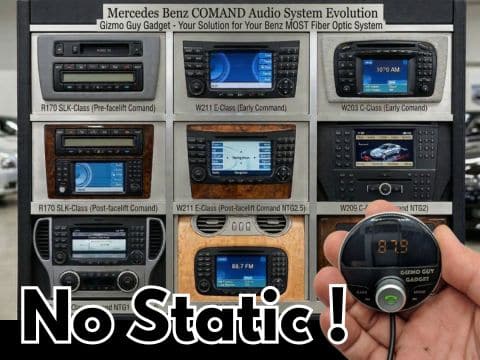
That old Mercedes cabin still feels right when you shut the door. Solid switchgear, real wood, clean gauges, factory stereo exactly where it belongs. Then you try to play music or take a call, and suddenly it feels 20 years older than the rest of the car. That is why the right bluetooth kit for mercedes matters – not as a gadget, but as a way to keep the car original while making it usable again.
If you own an older E-Class, S-Class, CLK, SL, CLS, ML, GL, or C-Class, you already know the bad options. FM transmitters sound thin and noisy. Universal adapters are hit or miss. Aftermarket head units wreck the dashboard, kill the factory look, and usually feel cheap in a cabin that was never cheap to begin with. A proper Mercedes Bluetooth upgrade should do one thing really well: add modern audio streaming and hands-free calling without making the car look modified.
What a bluetooth kit for Mercedes should actually do
A good kit is not just about pairing your phone. It should work with the factory system the way the car deserves. That means clean audio, fast connection, stable playback, and no weird workarounds every time you start the engine.
For most older Mercedes models, the real issue is the factory audio architecture. Many of these cars use fiber optic MOST systems or premium factory setups that do not play nicely with generic Bluetooth gear. That is where owners get burned. They buy a cheap adapter that claims broad compatibility, then spend a Saturday pulling trim apart only to find hiss, low volume, call problems, or no sound at all.
The better route is a vehicle-specific kit designed around the original Mercedes electronics. When the kit is matched correctly, you keep the stock radio, the stock amp behavior, and the stock interior. You just add the function the car should have had from the factory.
Why Mercedes owners usually hate the alternatives
Mercedes owners are not hard to please. They just know when something feels wrong.
An aftermarket touchscreen in a W211 or R230 often looks like exactly what it is – an aftermarket touchscreen shoved into a car that was designed before giant glossy displays took over. You lose that clean OEM symmetry. Sometimes you lose factory features. Sometimes sound quality takes a hit. Even when it technically works, it can cheapen the whole car.
FM transmitters are worse. They are the fast-food version of Bluetooth. Easy, cheap, and disappointing five minutes later. Static, interference, weak bass, random signal drift – none of that belongs in a Mercedes with a premium sound system.
The reason a dedicated Bluetooth integration kit makes sense is simple. It respects the car. It gives you wireless streaming and calling without asking you to butcher the dash or settle for garbage audio.
Which Mercedes models need a specialized solution?
This is where people get tripped up, because not every Mercedes radio setup is the same.
Late 1990s through early 2010s Mercedes vehicles can have very different factory systems depending on model, year, trim, and whether the car came with COMAND, navigation, CD changer, or premium audio. A 2003 E-Class is not the same as a 2009 CLS. An SL with fiber optic audio is a different animal than a base setup in another model. Even cars that look similar inside can require different integration methods behind the scenes.
That is why compatibility matters more than marketing. If a seller treats Mercedes like one big category, that is a red flag. The right kit should be tied to your specific model range and factory stereo type, not just the badge on the hood.
Common Mercedes generations owners upgrade
A lot of demand comes from cars that still feel modern everywhere except the infotainment. Think W211 E-Class, W219 CLS, R230 SL, W220 S-Class, W203 C-Class, W164 ML, X164 GL, and similar era Mercedes models. These are exactly the cars people want to preserve. They still drive beautifully, still look expensive, and still have interiors worth keeping stock.
For those owners, Bluetooth is not about turning the car into something new. It is about removing one daily annoyance without messing up everything that makes the car special.
Sound quality is the whole point
If your Mercedes has a premium factory audio system, you already know it can sound excellent. That is why low-grade Bluetooth solutions are so frustrating. They take a system that was engineered well and feed it junk.
A proper Bluetooth kit should deliver direct, clean audio into the factory setup with none of the static and hiss that plague FM-based workarounds. No radio interference. No constant level mismatch. No cheap, compressed, washed-out sound that makes every song feel smaller than it should.
This matters even more in Mercedes cabins because they are quiet enough to expose bad audio gear fast. In a noisy beater, maybe you tolerate it. In an S-Class or E-Class with decent insulation and a premium system, flaws stand out immediately.
So yes, Bluetooth is about convenience. But in a Mercedes, it is also about preserving the listening experience the car already earned.
Installation should not turn into a weekend project
Most owners want the same thing: plug it in, pair the phone, done.
A well-designed Mercedes Bluetooth kit should install quickly, without cutting factory wiring or replacing visible dash components. That is the sweet spot. You get modern function with minimal disruption, and if originality matters to you, that is a big deal.
There is also a resale angle here. Clean upgrades are easier to live with and easier to explain to the next owner. A reversible, hidden integration is a lot more attractive than hacked trim, spliced wires, or some generic control box zip-tied under the console.
Not every owner is a DIY wizard, and that is fine. The best kits are the ones that do not require you to become one.
Hands-free calling matters more than most people admit
A lot of people shop for streaming music first, then realize calling is what changes daily driving the most.
If your old Mercedes is still a commuter, road-trip car, or daily cruiser, hands-free calling is not a luxury anymore. It is just basic usability. The trick is getting it without the usual junky microphone performance or clumsy controls that make every call sound like a drive-thru speaker.
A quality kit can make the car feel current again. You get in, your phone connects, music resumes, calls come through, and the whole experience feels natural. Not flashy. Just sorted.
That is really the goal with older luxury cars. Keep the character. Fix the one weak spot that reminds you the car came from another era.
How to choose the right bluetooth kit for Mercedes
Start with the car, not the feature list. Year, model, chassis, and factory stereo setup matter more than buzzwords on a product page. If the kit is designed specifically for Mercedes applications and the seller clearly understands factory audio differences, you are already in a better place.
Then ask the questions that actually matter. Does it preserve the stock head unit? Is audio quality direct and clean? Does it support calling as well as streaming? Is the installation non-destructive? Is it made for your exact system, especially if the car uses fiber optics?
That last point is where companies like Gizmo Guy Gadgets have built real credibility. Not with vague promises, but by focusing on the weird factory systems most universal brands do not understand and most big-box electronics sellers cannot explain.
It also helps to be honest about your priorities. If you want Apple CarPlay, giant touch controls, backup cameras, and app screens everywhere, you may be looking at a bigger aftermarket overhaul. But if what you really want is Bluetooth in a factory-correct Mercedes, with no static, no hiss, and no ugly dash surgery, the answer is usually a dedicated integration kit.
The best upgrade is the one that keeps the car feeling like a Mercedes
There is a reason owners hold onto these cars. They were built with a level of detail that still feels good years later. The steering, the seats, the way the interior comes together – it all has a point of view. A bad stereo upgrade cuts against that.
The right Bluetooth setup does the opposite. It fades into the background. The cabin still looks stock. The stereo still feels factory. The car still feels like itself. You just stop fighting it every time you want music, podcasts, navigation audio, or a phone call.
That is the standard worth aiming for. Not more screens. Not more clutter. Just the one upgrade that makes your Mercedes easier to enjoy without taking anything away from why you bought it in the first place.
If you are going to modernize an older Mercedes, do it the same way the car was built – thoughtfully, cleanly, and without shortcuts.