

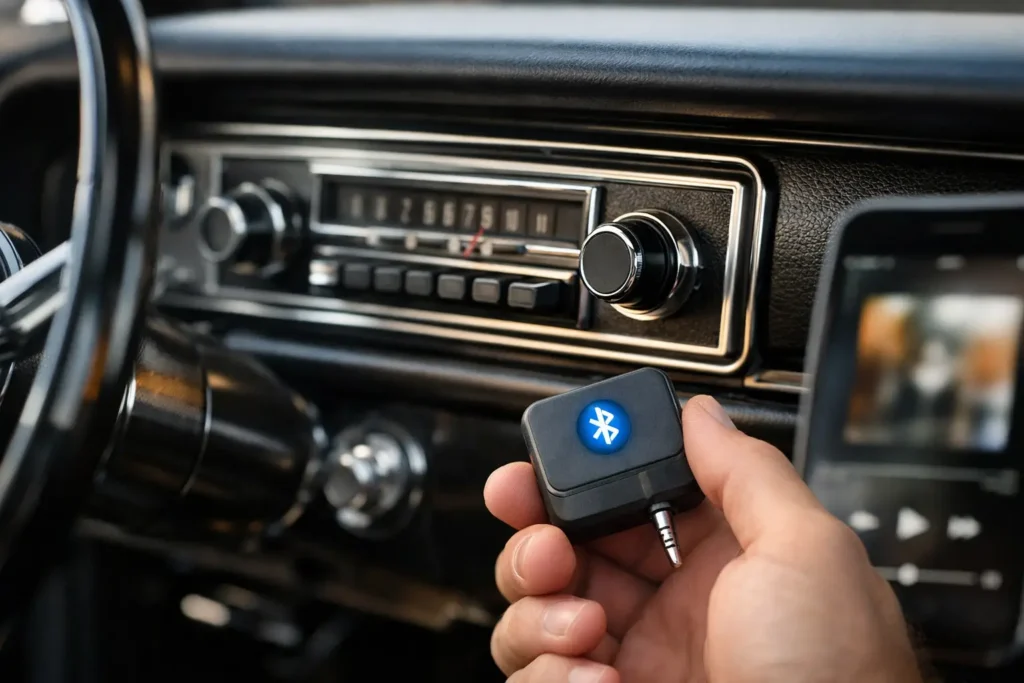
You know the moment. You pair your phone, hit play, and that old FM transmitter reminds you why you hate it. Static on the highway, hiss between songs, weak bass, random interference from the station two towns over. If you’re looking for an fm transmitter alternative for factory radio, you’re probably not trying to build a custom stereo show car. You just want your phone to work through the factory system without turning your interior into a cheap aftermarket mess.
That’s the real split. Most owners of older Mercedes, Lexus, BMW, Porsche, Audi, Corvette, and similar cars are not asking for more screens, neon menus, or a head unit that looks like it belongs in a rental-spec economy car. They want Bluetooth audio and hands-free calling while keeping the dash stock, the sound quality right, and the car feeling like itself.
What makes an FM transmitter the wrong tool
FM transmitters became popular for one reason – they were easy. Plug one into a power outlet, find an empty frequency, and call it done. The problem is that easy and good are not the same thing.
An FM transmitter compresses your audio, rebroadcasts it over a radio frequency, and asks your factory tuner to pick it back up cleanly. That chain is compromised from the start. You’re stacking one weak signal on top of another, and the result is exactly what most owners hear: background noise, volume inconsistency, muddy vocals, and interference that changes depending on where you drive.
That might be tolerable in a basic commuter. It feels ridiculous in a well-kept E-Class, LS, 911, A8, or C5 Corvette with a premium factory audio system that was actually pretty serious hardware in its day. If your car came with a Bose, Mark Levinson, MOST fiber optic, or other upgraded OEM setup, feeding it through an FM transmitter is like wearing work boots to a black-tie dinner. It technically works. It still looks wrong.
The best fm transmitter alternative for factory radio owners
For most factory-radio owners, the best FM transmitter alternative is a direct-integration Bluetooth kit that connects to the factory audio path instead of broadcasting over FM.
That’s the key difference. Instead of pretending to be a radio station, a proper integration module talks to the car’s audio system the way an OEM source would. In the right vehicle, that means cleaner sound, stronger output, more stable playback, and no chasing blank frequencies every time you cross county lines.
If you care about keeping the original head unit, this is usually the sweet spot. You get modern streaming and often hands-free calling, but the dash stays original. No faceplate adapters. No hacked trim. No sketchy universal wiring. No explaining to the next owner why the interior suddenly looks like 2007 aftermarket catalog leftovers.
Why direct integration sounds so much better
It comes down to signal path. FM transmission is indirect by design. A direct-integration kit sends audio into the factory system without that radio-frequency detour, so you avoid the static and hiss that make FM adapters so frustrating.
You also keep more of what makes your original system good. Better separation, fuller bass, clearer highs, and volume that feels normal instead of thin and strained. If you’ve been living with an FM transmitter for years, the first thing you notice is not some audiophile magic trick. It’s that the noise is gone. The second thing you notice is that your car suddenly sounds like it should have sounded all along.
Not every alternative is equal
This is where people get tripped up. “FM transmitter alternative” can mean a few different things, and some are a lot better than others.
Aux adapters are usually the simplest step up, if your car supports one. They can sound good, but many older luxury cars never had a true factory aux input, and plenty of owners don’t want cables hanging out of the console all the time. It solves the FM problem, but not the convenience problem.
Cassette adapters are another old-school workaround. They can be fine in the right car, but they’re a compromise and they’re obviously limited to vehicles with cassette decks. Sound quality is inconsistent, and in a premium cabin they rarely feel like a serious long-term answer.
A full aftermarket head unit can add every modern feature under the sun. It can also wreck the look of the dashboard, create fitment headaches, break factory integration, and cheapen the ownership experience of a car that deserved better. In some vehicles, especially fiber optic systems, replacing the radio gets expensive fast and can turn into a wiring project you never wanted.
That’s why vehicle-specific Bluetooth integration sits in a different category. It’s not a generic workaround. It’s a purpose-built solution for people who want the factory radio to stay put.
Factory radio preservation matters more than people admit
A lot of owners start this search thinking only about music. Then they realize the radio is tied to the whole personality of the car.
On older luxury and enthusiast vehicles, the factory head unit is part of the interior design. It matches the lighting, the switchgear, the fit and finish, and the era of the car. Swap it for a universal touchscreen and suddenly the cabin feels off. Not broken, exactly. Just cheapened.
That matters if you care about originality, resale, or simply enjoying the car the way it was meant to feel. Preservation is not some museum-only mindset. It’s practical. A stock-looking interior ages better, attracts better buyers, and usually gives you fewer electrical headaches than a pile of adapters and spliced wires.
For the right owner, the best upgrade is the one you barely see.
Who should skip the universal gadgets
If your car is from the late 1990s through early 2010s and has a premium factory audio system, universal gadgets are usually where disappointment begins. This is especially true in vehicles using fiber optic audio networks or brand-specific OEM amplifiers. Those systems were not designed around generic plug-it-into-the-cigarette-lighter accessories.
That doesn’t mean every install needs to be complicated. Quite the opposite. The right kit for the right vehicle can be surprisingly fast and clean. But the fit has to be specific. Mercedes is not Lexus. A BMW trunk-mounted module setup is not the same as a Corvette Bose arrangement. Details matter.
That’s why compatibility should come before features. A product that claims to fit everything usually fits nothing particularly well. A product built around your exact platform is far more likely to deliver the one thing you actually want: get in, connect, play music, and stop thinking about it.
What to look for in an FM transmitter replacement
If you’re shopping for an FM transmitter alternative for factory radio use, focus less on marketing fluff and more on how the solution behaves in a real car.
First, sound quality has to be the baseline. No static. No hiss. No weird digital artifacts. If the whole point is to escape FM-level audio, then the replacement needs to sound like a real source, not a cleaner version of a bad workaround.
Second, it should preserve the dash. If the install requires cutting trim, replacing the radio, or hanging wires where you can see them every day, that’s a step backward for most premium older vehicles.
Third, it needs to match the car. Vehicle-specific compatibility is not a luxury here. It’s the difference between OEM-like performance and a frustrating Saturday spent chasing wiring diagrams.
Fourth, calling support matters if you plan to use it. Some owners only care about streaming music. Others want reliable hands-free calling through the factory system. Know which one you are before you buy.
And finally, installation should be realistic. Not “simple” in the fake marketing sense. Actually realistic. If a solution is designed properly, it should respect the fact that most owners want results without turning the garage into an electronics lab.
Why enthusiasts end up here after wasting money first
A lot of people do this backward. They try the cheap FM transmitter. Then a better FM transmitter. Then a Bluetooth-to-aux dongle. Then maybe a universal adapter that almost works. By the time they’re done, they’ve spent enough money to buy the right solution once.
That pattern is common because the cheap fixes promise convenience. But what owners of premium older cars really want is permanence. They want to solve the problem and move on.
That’s exactly why brands like Gizmo Guy Gadgets exist. Not for people who want the cheapest gadget on page one. For people who are done messing around and want Bluetooth added to the factory system the right way.
If your car is worth keeping, it’s worth upgrading in a way that respects it. The goal is not to modernize everything. The goal is to modernize the part that matters, without disturbing the rest.