

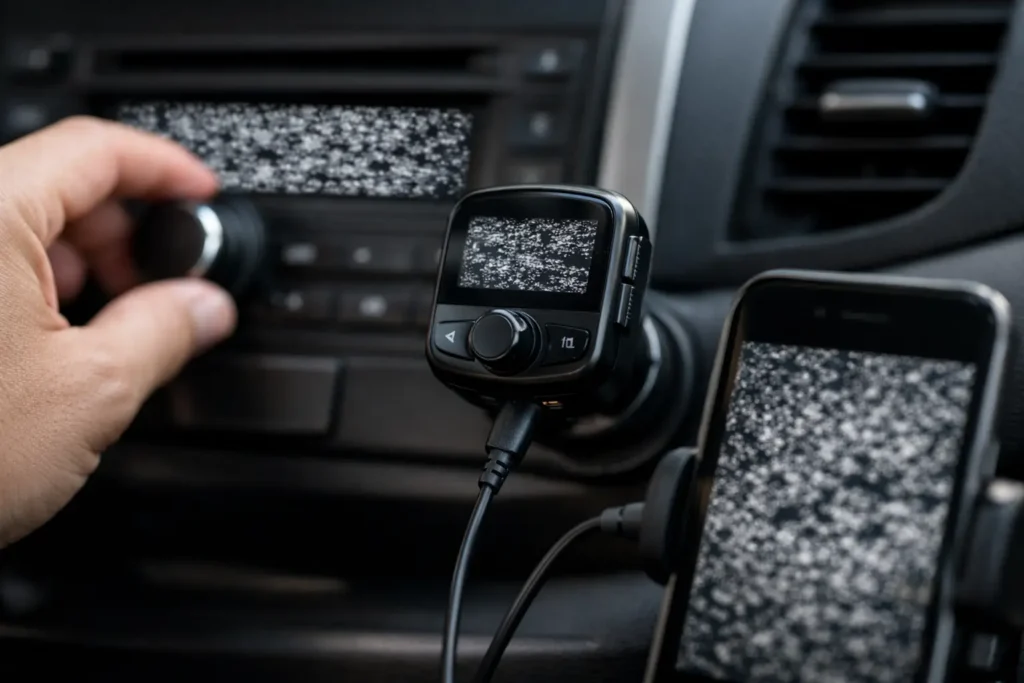
That crackly wash of hiss between songs is usually the moment people realize the cheap shortcut was not actually a shortcut. If you are trying to fix static from FM transmitter noise in an older Mercedes, Lexus, BMW, Porsche, Corvette, Audi, or similar car, the first thing to know is simple – the transmitter is usually not broken. It is doing exactly what FM transmitters do: fighting for space on a crowded radio band and losing sound quality in the process.
That matters more in older luxury cars because the factory systems were actually good. You are feeding a premium amplifier and speaker setup with a weak little broadcast signal, then wondering why it sounds flat, noisy, or inconsistent. The problem is not your ears. The problem is the method.
Why FM transmitters get static in the first place
An FM transmitter takes your music or phone audio and broadcasts it over a tiny local FM frequency so your factory radio can pick it up. That sounds convenient, and technically it is. But it is also the audio equivalent of yelling across a crowded parking lot.
FM radio bands are full of interference. Nearby stations bleed into your chosen frequency. Your car moves from one part of town to another and suddenly that “empty” station is not empty anymore. Electrical noise from chargers, poor grounding, and bargain-bin adapters makes things worse. Even when everything is working correctly, FM transmission compresses the sound and raises the noise floor.
In other words, static is not always a defect. Sometimes it is just baked into the setup.
How to fix static from FM transmitter setups
If you already own one and want to improve it before throwing it in the glove box forever, there are a few things worth trying.
Pick a truly unused FM frequency
This sounds obvious, but most people choose a station that seems empty while parked in their driveway. Then they start driving and another station starts bleeding in. You want the cleanest frequency in the actual areas where you drive most.
Lower-power stations, college stations, and regional broadcasts can creep in unexpectedly. Try a few frequencies at both ends of the FM band and test them on your commute, not just in your garage. If one spot gets noticeably less hiss and less station overlap, lock it in.
Turn down your phone volume a bit
A lot of people run phone volume at 100 percent, then wonder why the sound gets hashy or distorted. Some FM transmitters overdrive easily. If the input signal is too hot, it can create harshness that sounds like static even though it is really clipping.
Back the phone down slightly and raise the car stereo volume instead. It is not magic, but it can clean up the signal enough to make the setup tolerable.
Get the charger out of the equation
Cheap USB chargers are noise machines. They dump electrical interference into the power socket, and FM transmitters are already living on the edge. If your static gets worse when you plug in a phone charger, you have found at least part of the problem.
Try the transmitter without charging the phone. If the noise drops, the charger or power supply is contaminating the signal. A better power adapter may help, but this is also where people start realizing they are stacking compromises on top of compromises.
Reposition the transmitter
Some transmitters work better when they sit farther from other accessories, dash electronics, or metal obstructions. If your unit has a flexible neck or separate cable, changing its position can slightly improve reception.
Will moving it two inches suddenly create concert-grade sound? No. But if the signal between the transmitter and your antenna is weak or uneven, placement can matter more than people expect.
Clean the power socket
Older cars collect dust, oxidation, and years of junk in the cigarette lighter or 12V socket. If the transmitter is not getting stable power, you can hear pops, dropouts, or background noise.
A dirty socket is not the most common cause of FM static, but on a 15- to 25-year-old car, it is worth checking. Loose fitment can also create intermittent noise when the car hits bumps.
Stop using the strongest local stations as reference points
Sometimes people think the transmitter sounds bad because the radio itself sounds better on real FM stations. That is true, but it misses the point. Broadcast stations are using professional transmission gear, not a tiny plug-in adapter from a parts store. You are comparing a homemade workaround to a full radio infrastructure.
If your transmitter sounds weak next to local FM, that is normal. The question is whether it sounds good enough for you. For a lot of owners of premium factory systems, the answer ends up being no.
The part nobody likes to hear
You can reduce static. You usually cannot eliminate it.
That is the honest answer. If your goal is “good enough for podcasts on a quick drive,” an FM transmitter might be fine after some tweaking. If your goal is clean music streaming, real bass, stable volume, and no hiss in a car that originally came with a serious sound system, FM is the wrong tool.
This is why owners of older luxury and enthusiast cars get frustrated. They do not want to butcher the dash with a generic aftermarket head unit. They want Bluetooth, but they also want the interior to stay original and the sound quality to stay worthy of the car. FM transmitters promise convenience, but they usually deliver compromise.
When static is really telling you to stop using FM
There is a difference between solving a problem and babysitting a bad setup. If you are constantly retuning frequencies, unplugging chargers, fiddling with volume levels, or hearing different noise depending on where you drive, the transmitter is not serving you. You are serving it.
That is the line where a direct-integration solution starts making a lot more sense. Instead of converting your audio into a tiny FM broadcast and asking the radio to catch it, a proper vehicle-specific Bluetooth integration feeds the factory system the way it should have been fed in the first place. No broadcast layer. No station hunting. No static as part of the deal.
For cars with factory premium audio, especially fiber optic systems from the late 1990s through early 2010s, that difference is not subtle. The whole point is keeping the original head unit, keeping the factory look, and losing the cheap-adapter sound.
Fix static from FM transmitter noise or replace the method?
That depends on what kind of owner you are.
If this is a spare car, a weekend beater, or something you just need to get by in for a few months, squeezing the best out of an FM transmitter may be worth it. Use a clean frequency, avoid noisy chargers, and accept the limitations.
If this is your clean E-Class, your LS, your C5, your 5 Series, your 911, your A8, or any other car you actually care about preserving, there is a point where patching the workaround stops making sense. The factory stereo in those cars deserves a cleaner signal path than a tiny radio rebroadcast.
That is why companies like Gizmo Guy Gadgets exist in the first place. Not to sell another universal gadget with big promises, but to give owners a way out of the FM-transmitter cycle without hacking up the dashboard.
What better audio should actually feel like
Better does not just mean louder. It means the background hiss is gone. Vocals stop sounding smeared. Bass has shape again. Phone calls do not sound like they are trapped inside a coffee can. You get in the car, the system connects, and it just works.
That last part matters. A lot of enthusiasts are willing to spend money to avoid doing something twice. Buying one more transmitter, one more charger, one more noise filter, and one more adapter is usually more annoying than just fixing the root problem.
If you are still trying to make an FM transmitter behave, try the simple fixes first. But if the real goal is preserving the car and enjoying the sound system you already paid for when the car was new, static is not just a nuisance. It is your clue that the workaround has hit its ceiling.
Your car can keep its factory look without keeping the factory-era limitations.